 Horme
HormeA food diary that doesn't make you weigh your food
The reason almost nobody lasts a month counting calories isn't willpower: it's that logging costs more than it gives back. Horme goes straight at that.
- 2,136foods with full macros
- 100 %covered by household measures
- 4ways to log: search, photo, voice or barcode
- 0connection needed to log
"2 eggs", not "112 grams of egg"
Nobody thinks in grams. You think in eggs, cups, tablespoons, slices and glasses. Horme takes the unit you already think in and does the conversion underneath — all 2,136 foods carry their household measures, not just the hundred most popular ones.
| You type | Horme logs | Detail |
|---|---|---|
| 2 eggs | ≈ 112 g | Medium egg, with its white-to-yolk ratio. |
| 1 cup of cooked rice | ≈ 158 g | Cooked, not raw: the difference is 200 kcal. |
| 1 tablespoon of oil | ≈ 14 ml | Liquids are logged in millilitres, not grams. |
| 1 glass of milk | ≈ 250 ml | Without offering you "a glass of oil", which is not a thing. |
Data quality travels with the number
An estimated calorie is not presented as a measured calorie. Horme retains source, coverage, preparation state and uncertainty before adapting a target.
Per-nutrient provenance
FoodData Central and Open Food Facts retain identifier, version, unit and source; missing stays null, never an invented zero.
Adaptation that is compared
Adaptive expenditure is compared with formula and wearable estimates over coherent windows, and abstains until enough data exist.
Safety gate
Blocks automatic deficits for minors, pregnancy, eating-disorder history, kidney disease, diabetes or relevant medication without professional supervision.
Planning and permissions
Budget, pantry, substitutions and hard allergen filters; professional access has scope, expiry, revocation and audit.
Log it whichever way is fastest for you
Barcode
Point at the packet and done. If it is not in the local database, Open Food Facts is queried and the result is cached.
A photo of the plate
The AI identifies what's there and anchors it to the local database instead of inventing macros. You confirm the amounts before anything is logged.
Dictation
"Chicken with rice and a salad" while you do the dishes. Voice → text → macros, with the same confirmation step.
Logging memory
What you always eat floats to the top. Your daily breakfast goes in with one tap.
Why anchoring to the local database matters
A free-running AI will tell you a plate has "about 600 calories" with total confidence. Horme forces it to pick real foods from its own database and then checks the calories against the macros using the Atwater factors. When they disagree, arithmetic wins.Calories calculated from your real expenditure
Your daily target isn't a fixed formula: if your watch reports the day's expenditure, Horme uses it. On a 14,000-step day you eat differently than on an office day, and the target says so.
Protein, fat and carbohydrate split according to your goal — recomposition, cutting or gaining — with fibre, hydration and diet quality as first-class metrics, not decoration.
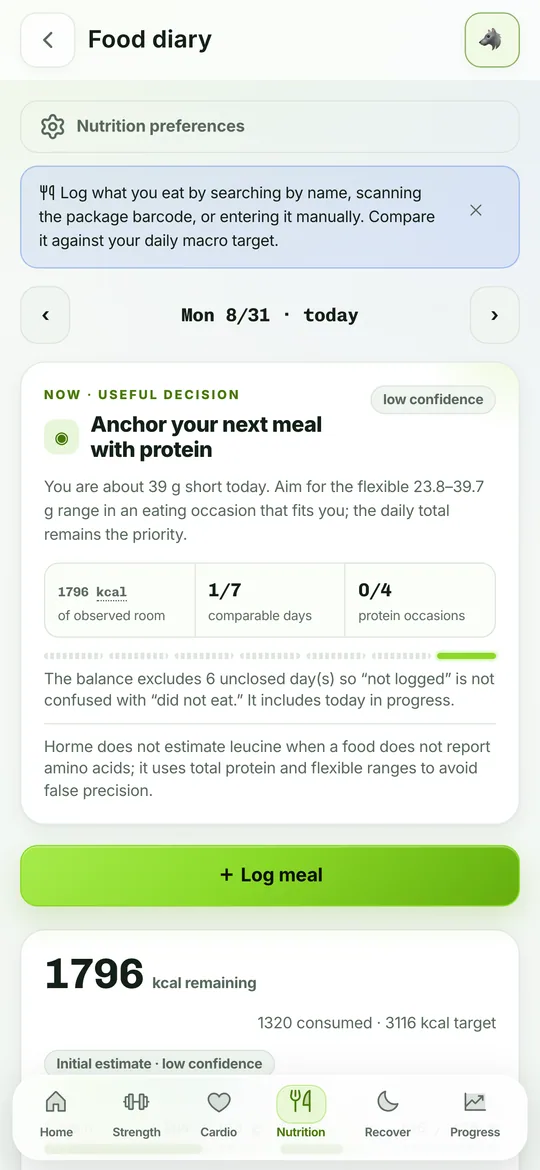
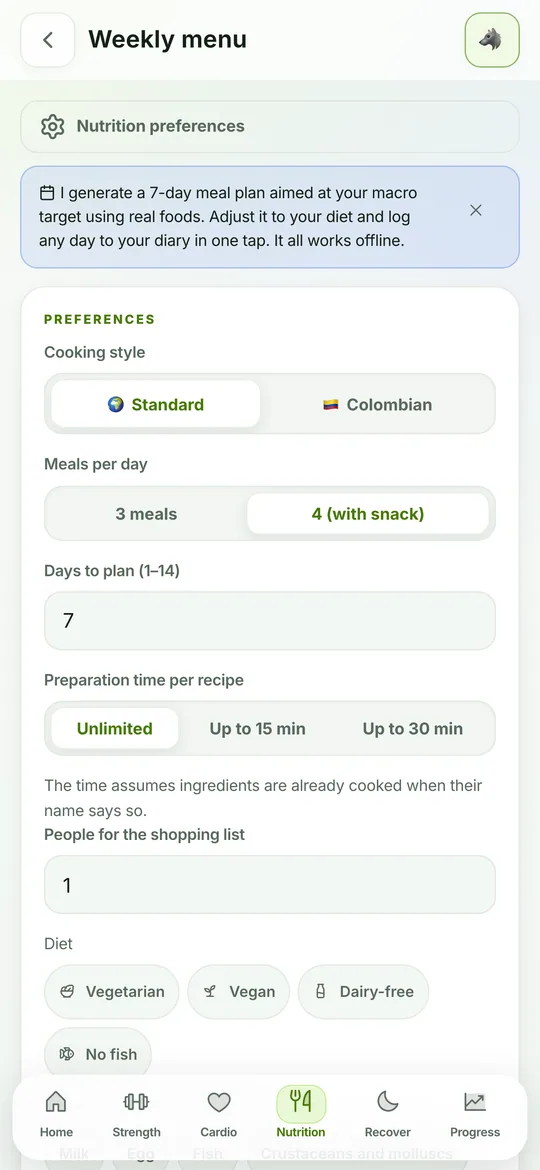
A meal plan you can adjust
Plan one to fourteen days around your targets, preferences, restrictions, pantry and variety. Swap recipes and review your shopping list.
Targets are a reference, not a guarantee: when constraints prevent meeting them all, Horme shows the trade-offs so you can review them.
It runs offline and without AI: it's an in-house allocation engine, so it doesn't depend on signal or on any quota being left.
And also
- Saved recipes and meals: build a plate once, log the whole thing later
- Intermittent fasting timer with the usual windows
- Water target calculated from sex, weight and activity — not a generic "2 litres"
- Sodium and fibre from Open Food Facts when the product declares them
- Supplements: 20 entries ranked by evidence level, including the ones that don't work
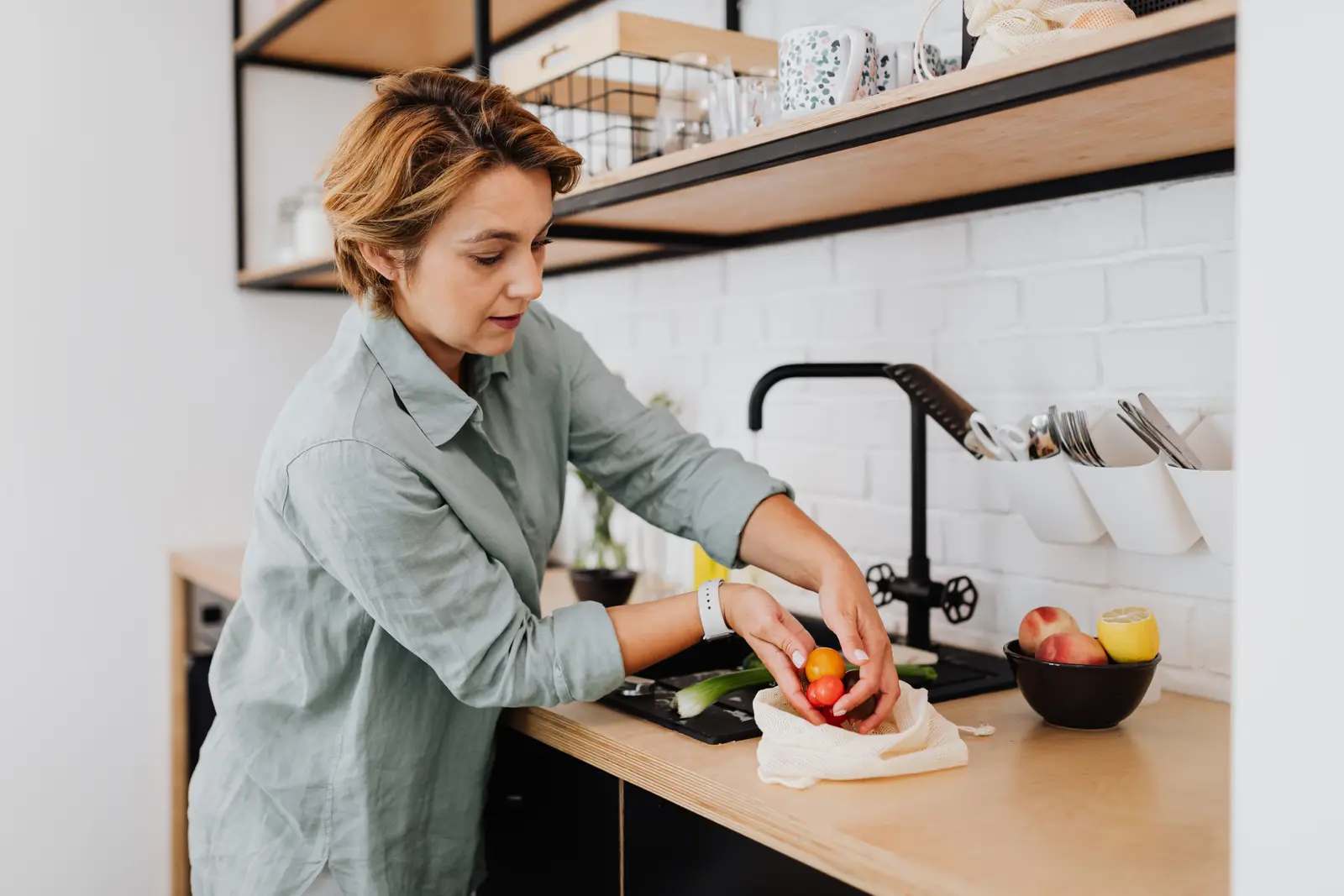
Real food, not grams
"2 eggs", "1 cup of rice", "1 tablespoon of oil". The app does the grams; you just describe the plate.
"Two eggs and a cup of rice"
is already a log
Log in household measures and Horme does the grams. Weighing every plate is the number one reason people abandon a food diary in week two.
Try logging one meal
No scale, no account, no connection. If it takes you more than thirty seconds, we did our job badly.
Free. No account required. Works offline from the first launch.